





In today’s hyper-connected world, reliable in-building connectivity is no longer optional it is a core business requirement. Distributed antenna systems DAS play a critical role in ensuring seamless wireless coverage across large facilities, campuses, and high-density environments. As organizations scale digital operations, support mobile workforces, and adopt cloud-based applications, the demand for uninterrupted cellular performance continues to grow. This is where distributed antenna systems DAS become essential infrastructure rather than a luxury.
Businesses partnering with experts like Instrata can leverage advanced DAS solutions to eliminate dead zones, improve network reliability, and support next-generation connectivity requirements such as 5G and IoT integration.
Understanding Distributed Antenna Systems DAS
Distributed antenna systems DAS are engineered networks of spatially separated antennas connected to a common source. Their primary function is to enhance wireless signal coverage and capacity inside buildings or across large outdoor venues.
Unlike traditional cellular setups that rely on a single high-power transmitter, DAS distributes the signal through multiple low-power antennas. This ensures more consistent coverage, especially in structures with challenging layouts such as:
- High-rise office buildings
- Hospitals and healthcare campuses
- Airports and transportation hubs
- Stadiums and entertainment venues
- Industrial warehouses and manufacturing facilities
The result is stronger indoor connectivity, reduced dropped calls, and improved data performance for users across the network.
Why Distributed Antenna Systems DAS Matter in 2026
Modern enterprises depend heavily on mobile communication, real-time data access, and cloud applications. However, traditional wireless infrastructure often struggles to meet these demands in dense or architecturally complex environments.
Here’s why distributed antenna systems DAS are increasingly important:
1. Rising Data Consumption
With video conferencing, IoT devices, and cloud platforms becoming standard, bandwidth demand inside buildings is higher than ever.
2. Complex Building Materials
Concrete, steel, and energy-efficient glass significantly weaken cellular signals indoors.
3. 5G Expansion
While 5G offers high-speed connectivity, its shorter wavelength makes it more difficult to penetrate buildings without additional infrastructure like DAS.
4. User Experience Expectations
Employees and customers expect seamless mobile connectivity everywhere consistent coverage is now a competitive advantage.
How Distributed Antenna Systems DAS Work
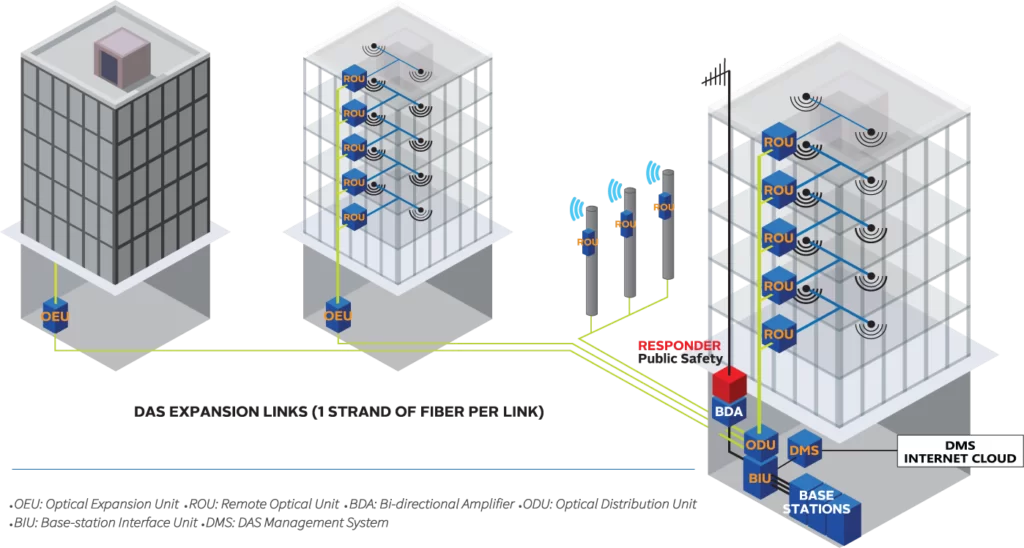
A typical DAS architecture consists of three key components:
1. Signal Source
The system begins with a signal source, which can be a carrier base station, small cell, or off-air antenna. This source feeds the network with cellular signal.
2. Distribution Network
Fiber optic or coaxial cables distribute the signal throughout the building or campus. This backbone ensures minimal signal loss over distance.
3. Remote Antenna Units
These antennas are strategically placed throughout the coverage area. They broadcast the signal evenly, ensuring users experience consistent performance regardless of location.
Together, these components create a unified wireless ecosystem that enhances both coverage and capacity.
Types of Distributed Antenna Systems DAS
Different environments require different DAS configurations. The most common types include:
Passive DAS
Passive systems use coaxial cables and splitters to distribute signals. They are cost-effective and suitable for smaller buildings.
Active DAS
Active systems convert signals into optical or digital formats for transmission over fiber. They support larger and more complex installations.
Hybrid DAS
Hybrid systems combine passive and active components, offering a balance of performance and cost efficiency.
Public Safety DAS
Many jurisdictions require dedicated DAS networks for emergency responders, ensuring reliable communication during critical situations.
Key Benefits of Distributed Antenna Systems DAS
Investing in distributed antenna systems DAS delivers measurable advantages across operational, technical, and user experience dimensions.
Improved Indoor Coverage
DAS eliminates dead zones by ensuring uniform signal distribution across all building areas.
Enhanced Network Capacity
By distributing load across multiple antennas, DAS reduces network congestion during peak usage periods.
Better Call Quality and Data Speed
Users experience fewer dropped calls, faster data speeds, and improved application performance.
Scalability for Future Technologies
Modern DAS infrastructure supports upgrades to 5G and beyond, making it a future-ready investment.
Increased Productivity
Reliable connectivity enables employees to work efficiently without disruptions caused by poor signal quality.
Distributed Antenna Systems DAS vs. Signal Boosters
A common misconception is that signal boosters and DAS systems serve the same purpose. While both improve cellular coverage, they differ significantly in scale and capability.
- Signal Boosters: Amplify existing signals for small areas such as homes or small offices.
- DAS: Designed for large-scale environments requiring consistent coverage across multiple floors or buildings.
For enterprise environments, DAS is the more robust and scalable solution, especially where multiple carriers and high user density are involved.
Deployment Considerations for Businesses
Before implementing distributed antenna systems DAS, organizations should evaluate several critical factors:
Building Size and Layout
Complex structures may require hybrid or active DAS configurations for optimal performance.
Carrier Coordination
Engaging mobile network operators early ensures compatibility and regulatory compliance.
Future Growth Needs
Businesses should design DAS infrastructure with scalability in mind, especially as 5G and IoT adoption expands.
Integration with Existing Systems
DAS should complement Wi-Fi networks, small cells, and other wireless infrastructure rather than replace them entirely.
Common Challenges in DAS Implementation
While DAS provides significant advantages, deployment can present challenges:
- High initial installation costs
- Complex design and engineering requirements
- Coordination with multiple carriers
- Regulatory approvals in certain regions
However, these challenges are often outweighed by long-term performance gains and operational efficiency.
The Role of DAS in Smart Buildings
Smart buildings rely on interconnected systems security, HVAC, IoT sensors, and communication networks all depend on stable connectivity. Distributed antenna systems DAS serve as the backbone that supports these technologies by ensuring uninterrupted wireless communication.
As businesses adopt smart infrastructure, DAS becomes increasingly integrated with:
- Building management systems (BMS)
- IoT sensor networks
- AI-driven analytics platforms
- Cloud-based communication tools
This integration helps organizations improve operational visibility and efficiency.
Future Trends in Distributed Antenna Systems DAS
The evolution of DAS is closely tied to advancements in wireless technology. Key trends include:
5G-Optimized DAS
Systems are being designed specifically to support high-bandwidth, low-latency 5G applications.
Virtualized and Cloud-Managed DAS
Remote monitoring and management through cloud platforms are becoming standard.
Energy-Efficient Designs
New architectures focus on reducing power consumption while maintaining performance.
Integration with Edge Computing
DAS will increasingly support edge data processing for real-time applications.
Why Choose Instrata for Distributed Antenna Systems DAS
Instrata brings expertise in designing and deploying scalable wireless infrastructure tailored to enterprise needs. Their approach focuses on delivering reliable connectivity solutions that align with modern business demands.
By working with Instrata, organizations benefit from:
- Customized DAS design and engineering
- Carrier coordination and compliance support
- Scalable infrastructure planning
- Long-term performance optimization
Their experience ensures that distributed antenna systems DAS are implemented efficiently and effectively, supporting both current and future connectivity requirements.
Final Thoughts
Distributed antenna systems DAS are no longer optional for organizations operating in complex, high-demand environments. They are a foundational element of modern connectivity strategy, enabling reliable communication, improved productivity, and scalable digital transformation.
As businesses continue to adopt advanced technologies such as 5G, IoT, and smart building systems, DAS will remain central to ensuring seamless wireless performance. Organizations that invest in well-designed DAS infrastructure today position themselves for stronger operational resilience and long-term technological readiness.
With the right planning and implementation, providers like Instrata can help enterprises build connectivity environments that are prepared for current demands and future growth without compromising performance or reliability.